
The Legislative Process
How Congress Makes Laws

Article I, Section 1 of the Constitution states:
All legislative powers herein granted shall be vested in a Congress of the United States, which shall consist of a Senate and House of Representatives.
Congress’ primary power is that of legislating. Unfortunately, reading the Constitution provides little help in understanding the legislative procedure. There are a few important exceptions. Article I, Section 5 lays out four clauses addressing practical aspects of the legislative process.1One is that both chambers must record their actions. Another is that the specific votes of individual members must be recorded on the request of one-fifth of the members present. This is known as “ordering the years and nays.” In the Senate it is taken one at a time as the clerk calls out members’ names. In the House the procedure has been electronic since 1973. All of this and more is kept in the daily publication of Congressional Record.
Another Constitutional imperative is that all tax bills must originate in the House of Representatives. That power is often called the power of the purse. As the Constitution says it: “all bills for raising revenue shall originate in the House of Representatives; but the Senate may propose or concur with amendments as on other bills.”
Two more Constitutional requirements are, according to Article I, Section 5, that “a majority of each [chamber] shall constitute a quorum to do business.” In short, a majority of members must be present. Finally, the Constitution outlines the process of presidential approval or veto of legislation in Article I, Section 7 and again in Article II.
Besides these four major areas the Constitution leaves to each chamber the power of determining rules and procedures for the purposes of law making. Article I, Section 5 of the Constitution states “each House may determine the Rule of its own proceedings.” The House of Representatives has nearly 60,000 words governing its procedures and the Senate 29,000. Each chamber, House and Senate, operate differently because they have different rules and histories. These rules of proceedings are yet another one the House and Senate differ from each other in practice.
House and Senate Rules
The House and Senate consider themselves — based primarily on their length of term and the number of members who go up for election every two years — differently. The House views itself as a temporary body. All 435 of its members can, theoretically, be turned out of office in any election. For the House that means that all members could be rejected by voters in any two year election cycle. As a result House rules are voted on the first day of each new session of Congress. The Senate considers itself a continuing body because only one-third of its membership go up for election in any two year cycle. Therefore the Senate operates under continuous standing rules which are amended from time to time. Senators individually each have a six year term.
Due to Article I, Section 5, both House and Senate have very different legislative processes. For example, Senate Rule 22 requires Senators to meet a three-fifths threshold instead of simple majority to end debate (called invoking cloture). These rules create vastly different environments for passing laws.
Sources of Legislation
Form where does legislation come? It might be easy to simply say: members of Congress, but the truth is more complex. In general there are three primary source of legislation:
1. Drafts by members
2. Petitions from constituencies
3. Executive Communication
The most common is a member of Congress drafting an idea. Often this comes in response to a campaign promise. Of course any member can introduce a bill, so it is a relatively easy promise to keep.
Additionally, a Congresspersons’ constituency may petition them. The 1st Amendment guarantees the right of petition to ensure constituents can inform Congresspersons of their feelings and desires.
In the contemporary era executive communication is a key source of legislative proposals. Today presidents are seen as leaders of their party and of the country. This includes convincing Congress to pass legislation. Executive communication usually comes in the form of a message or letter from a cabinet member or the head of an agency, or, sometimes, from the President directly. In this case a proposed bill will be given to the Speaker of the House of Representatives and the President of the Senate.
Article II, Section 3 of the Constitution requires the president to report to Congress on the “State of the Union” and then to recommend items for consideration. This too is often a source of executive communication.
It should be made plain that a president cannot introduce legislation. Neither can a constituent. Instead, only a member of Congress may take that step. Presidents will try and influence members to introduce and adopt legislation and members of the general public may lobby, but ultimately the process rests in the hands of those individuals who have seats in the House and the Senate. It is to that lawmaking process we now turn.
Forms of Congressional Action
Once initiated there are four forms in which a proposal may be brought forward: a bill, a joint resolution, a concurrent resolution or a simple resolution.
A bill is the most used for legislation. It takes the form of describing what it is and giving it a title.
A joint resolution is nearly identical to a bill and the words are often used interchangeably. The biggest difference is that a joint resolution, in addition to a title, will also have a preamble. Another important difference is that joint resolutions are used for proposing Constitutional amendments. If approved such amendments are not sent to the President, but instead sent to the Archivist of the United States to be sent out to either state legislatures or ratifying committees.
Concurrent and simple resolutions are different and after 1983[^see INS v Chadha] these resolutions are not legislative in character and are not presented to the President. Concurrent and simple resolutions are used to express facts, principles, opinions and purposes of the two chambers. A simple resolution is to change something entirely in one chamber. If the Senate wishes to change its own rules for example it does not need the approval of the House or the President. That is a simple resolution.
The most customary -- and the one most pertinent -- is a House or Senate Bill. These kinds of motions are potential new laws and it is the kind of legislation that we will follow in this podcast.
Bill to Law Process
So how then does a bill become law? Before we begin it is necessary to begin by noting how hard it is to pass a law. It is a difficult process to make it through subcommittee, full committee, floor, then conference, then floor, not to mention doing it in not one, but *two*, chambers. Even after all of this it still requires the signature of the president or a significant majority of Congress to override the President.
If we look to the 115th Congress (the Congress which was in office from Jan 3, 2017 to Jan 3, 2019) while 15,022 pieces of legislation were introduced, only 443 passed (3%). The process is difficult indeed. What is this arduous process? It is the procedures of the House and the Senate.
Robert Michael lamented that “nothing is so boring to the layman ... [than] House procedures.”2It leads to what Michael called MEGO “my eyes glaze over.” Yet, understanding the rules of procedure are crucial. For us as citizens it means we must have at least a basic understanding of the legislative process. We must try to not glaze our eyes over as we realize the Congress is the very heart of the American lawmaking process. It is the heart of Our American Political System.
We are discussing the standard legislative process. This process can be circumvented, but it is a useful starting point for an introduction and can serve as the basis for a more detailed understanding for those who wish to go deeper. The goal here is to help listeners understand what they see happening in Congress so as to make wiser decisions in voting and petitioning Congress. It is not, and should not be considered, exhaustive of the process.
The output of legislation, laws, have changed over time. While the number of words has increased -- Congress typically enacts 4-6 million words of new law into each two-year Congress, the number of bills have decreased. We have larger, but fewer bills, as time goes on.3
That basic path in the house is: bills are introduced by a member, then sent to committee / subcommittee by the Speaker of the House, then to the rules committee, then to the full floor, potentially next to a conference committee, before then being sent to the president.
For the Senate the procedure is the same but there is no rules committee. Instead the rules of debate must be unanimously agreed upon. If they are not, then it is possible to filibuster.
House Resolutions are given the prefix of H.R. and Senate Bills are given the prefix of S. These prefixes refer to the chamber. That is H.R. is short for House of Represenative and S. For Senate. Because many states operate differently, these are often confused for House Resolution and Senate Bills.
Following the prefix is a number. There is no correlation between the chambers’ numbers. So H.R. 1’s companion bill is not S. 1 necessarily (or even probably). The term “companion bill” is used to describe a bill introduced similarly in another chamber of Congress. Companion bills need not share the same number.
There are a few other types of motions worth knowing.
Joint Resolutions: identical in form to a Bill but the main difference is it has a preamble.
Concurrent resolution: not legislative in character but merely express facts, principles, opinions, and purposes of the two houses.
Simple resolutions: concerning the rules operations, or opinion of either House alone.
Committees
To understand Congress one must understand that both chambers of Congress are composed of a variety of committees. The most important type for our purposes is the standing committee. Most of the business of each chamber, that is the bills mentioned above. Are handled first inside of committees dedicated to specific issue areas. In the Senate it requires unanimous consent to bypass the standing committee structure.
The number of bills that come out of committee are often low. Typically only 17 - 13 percent of bills come out of committee.
What do committees do? They are designed to screen legislation, receive information from the executive branch, receive recommendations from interest groups, and finally make changes -- markup -- legislation before bringing it before the full chamber floor.
If a bill makes up the 13 - 17% of bills that successfully come out of committee then rules must be attached to the bill. These are the rules of debate. How long will proponents and detractors have to discuss the matter? What kinds of amendments will be possible? These form the rules of debate.
In the house rules are attached to the bill -- how long to debate, the kind of amendments can be offered -- in the rules committee. The power to attach rules is critical and, therefore, the rules committee has significant power. Things are a bit more complicated in the Senate.
Most measures in the Senate are passed by unanimous consent. Unanimous consent agreements limit the debate, amendments, and motions possible when considering a bill. This is what the House’s rules committee does.
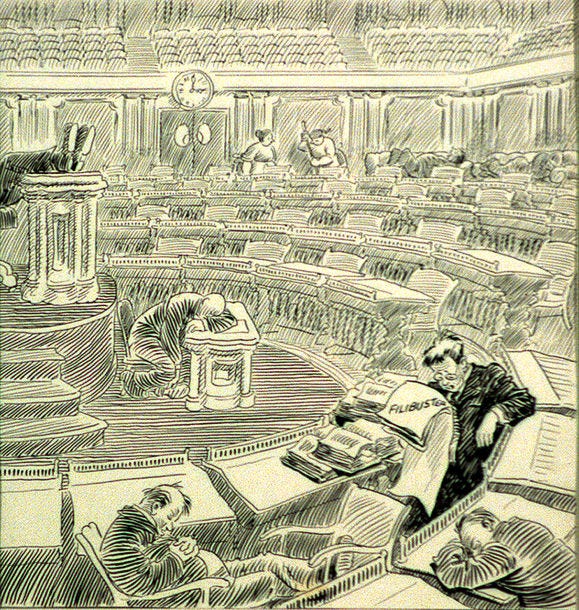
If a Senator objects to the normal process of unanimous consent, then it is necessary for the Senate to turn to cloture. Under Rule XXII if three-fifths of the Senate (that would be 60) votes in the affirmative, then debate on the question is limited to one hour for each Senator and the total time is limited to 30 hours.4 Bills that cannot meet this 60 vote minimum are often not brought forward. Passage is nearly impossible because the bill could be filibustered.
The origins of cloture is not in the Constitution. Instead it emerged in 1806 when, at the advice of Vice President Aaron Burr, the Senate changed the rules from needing a simple majority to end debate.5 There is earlier evidence that similar tactics were used even in the first Senate. An early source of information on the workings of the Senate come from Pennsylvania Senator William Maclay’s diary. On an entry from September 22, 1789, he wrote of the “design of the Virginians . . . was to talk away the time, so that we could not get the bill passed.”6 This was not, however, a formal filibuster.
The modern filibuster makes understanding cloture crucial. If the cloture cannot be invoked then it is possible to filibuster -- that is to block legislation by holding the floor indefinitely. Filibustering is possible because without cloture members of the Senate have the right to unlimited debate. And a debate that never ends stops the passage of a bill.7
Because filibusters are procedural they are not as exciting as as a Jimmy Stewart movie anymore. Although from time to time Senators will still hold the floor in order to make a point, filibusters are “generally ways to paralyze the Senate until the majority either finds 60 votes to proceed or gives up and moves on to another piece of business.”8
Today, for all practical purposes and for most types of legislation, if a bill cannot hit the 60 vote threshold, if cloture cannot be invoked, then it is dead before it begins.
Once either chamber has passed a bill it technically becomes an Act (although this isn’t language that is widely used outside of Congress). The chamber must then transmit the bill to the other chamber for consideration.
Bills may begin in either chamber -- unless they are raising revenue and then they must begin in the house -- but both chambers must ultimately vote for passage on an identical bill. There are two ways this can be achieved. One is through a conference committee the other is through each full chamber transmitting bills back and forth.
A conference committee is composed of members of both the House and the Senate and they must reconcile the difference between a Senate and a House version of a bill. The parties negotiate over what to change, but they have wide latitude to make changes in order to create a third version of the bill. Conference committees are temporary and either report on a bill if compromise is found or they dissolve.
If after conference both the Senate and the House pass identical versions of a bill it heads on to the executive branch after receiving the signature of the speaker of the House and the Vice-President.
The president, under the Constitution, has 10 days (Sundays excepted) after the bill has been presented to him in which to act. The president can also ask for a report from his own branch asking for a report on whether he or she should veto it. The president can either sign the bill or veto it. Signing it creates a new law. Vetoing the bill kills it.
Per the constitution, if the president takes no action and Congress is still in session after 10 days the bill becomes law without the president’s approval. If Congress adjourns during hose ten days and the president takes no action then the bill is pocket vetoed. That is it fails to become a law.
If the president vetos a bill, he returns it to the chamber in which it originated along with his objections. His objections are called a veto message. Now the House and Senate must decide what to do. If, after reconsidering the bill, Congress wishes to still pass the bill, then it must receive a two-thirds vote in both chambers which overrides the veto and the bill becomes law.
During the era of the modern presidency, a topic we will turn to in our next episode, presidents have evoked an additional tool during the law making process: a signing statement. FDR used it in 1943 for example. Signing statements are not a formal part of the legislative process and many ague they “have no legal effect.”9 Nixon was a proponent of signing statements, leading to the Supreme Court decision in DaCosta v Nixon in 1972 stating that bills enforcement exist even if the president disagrees. This view is hardly uniform and Ronald Reagan would go to great lengths to get the court to use signing statements when interpreting bills.
Robet H. Michel, “The Minority Leader Reports,” Washington Post, December 29, 1987, A14.
https://www.govtrack.us/congress/bills/statistics